
I’ve been homesteading for several years. I’ve raised chickens, managed a large garden, put up hundreds of jars of preserves, and built more than a few structures from scratch.
In all that time, the one thing I never found was a tool that understood the full picture. Not just the garden. Not just the animals. All of it, together, as a connected system.
That gap is where Homestead Helper started.
The Problem
Homesteading is not a single skill. It’s dozens of them, layered on top of each other, each with its own timing, its own dependencies, and its own failure modes.
You need to know when to start seeds indoors based on your last frost date. You need to know which crops work next to each other and which ones don’t. You need to track when your hens last molted, when you processed your last batch of meat birds, and how much feed you’re going through per week. You need to know how long your canned tomatoes are good for and what the signs of spoilage look like.
None of that knowledge lives in one place. You piece it together from YouTube videos, Facebook groups, old books, and advice from neighbors. You keep notes in a dozen different notebooks or apps that don’t talk to each other. You Google the same questions every spring because you don’t have a good way to retain what you learned last season.
The result is a knowledge problem. Not a lack of information, but a lack of organization and personalization. Generic advice is everywhere. Advice that accounts for your specific property, your climate, your animals, and your goals is almost impossible to find.
What Homestead Helper Does
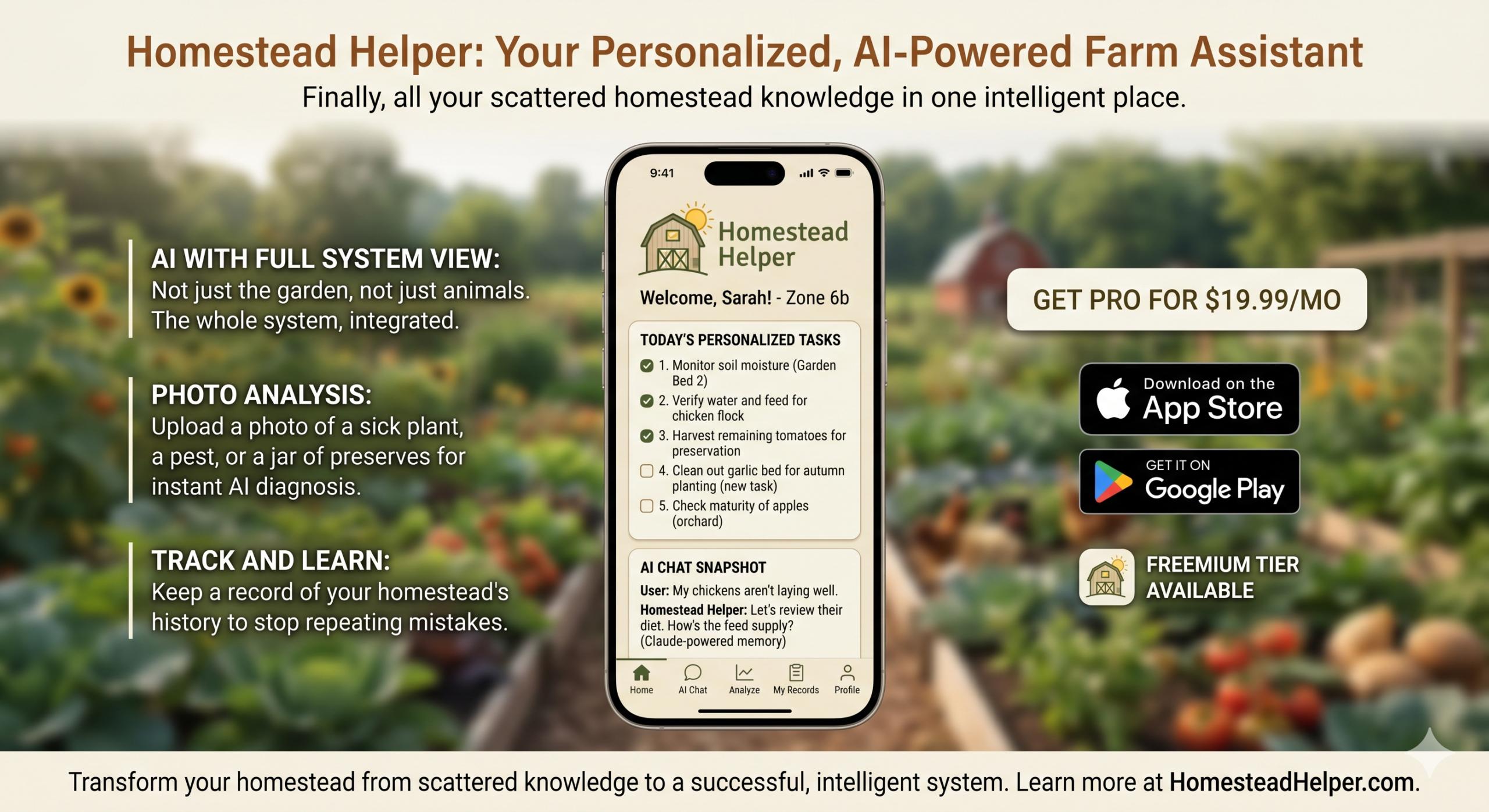
Homestead Helper is an AI-powered mobile app that serves as a comprehensive homestead assistant. It gives you personalized guidance on gardening, livestock management, food preservation, and infrastructure development, and it remembers your property across every conversation.
The core workflow:
- Start by completing a property profile. You tell the app your location, your property size, your current setup, and your goals. This context informs every response the AI gives you. Generic advice is replaced with guidance that fits your actual situation.
- Ask questions the way you’d ask a knowledgeable neighbor. What should I be planting right now? My tomatoes have yellow spots on the lower leaves, what’s wrong? How long do I need to brine these green beans before canning? The AI draws on a deep knowledge base built from real homesteading experience, not generic research.
- Track what matters. Log observations about your garden beds, your flock, your harvests, and your projects. The app builds a record of your homestead over time so you stop losing the lessons you’ve already learned.
- Get seasonal task recommendations. Based on your location and property profile, the app surfaces what you should be thinking about before you have to think about it. Frost dates, breeding windows, preservation season, infrastructure prep for winter.
- Use photo analysis to identify problems fast. Upload a photo of a sick plant, an unknown pest, or a questionable jar of preserves. The app analyzes the image and gives you a diagnosis with recommended next steps.
Who It Serves
Homestead Helper serves people across a wide spectrum of experience.
- Beginners who are starting from scratch and feel overwhelmed by how much there is to learn. The app gives them a clear, linear path through complex topics like permaculture principles and rotational grazing without requiring them to become experts before they take action.
- Experienced homesteaders who have the knowledge but lack organization. The app gives them a single place to track their property, log observations, and get quick answers to specific questions without having to dig through old notes or forums.
- Suburban micro-homesteaders who are growing food in limited space and want to maximize what they’re producing. They may have a small garden, a few raised beds, and maybe some backyard chickens. The app meets them where they are.
- Small farmers transitioning to more sustainable, regenerative practices. The app provides guidance that connects traditional knowledge with practical implementation.
How It’s Built
Homestead Helper runs on a cross-platform mobile stack built for reliability and personalization.
React Native for the mobile application, enabling a single codebase for iOS and Android.
Node.js and PostgreSQL on the backend, handling user profiles, conversation history, and property data.
The Anthropic Claude API as the primary AI engine. Homesteading queries benefit from Claude’s ability to reason across complex, multi-variable situations where context matters as much as facts.
Google Cloud Vision API for photo analysis and plant and pest identification.
AWS for infrastructure with CDN delivery for the knowledge base content.
Conversation history is summarized intelligently to manage context and keep the AI aware of your property details without ballooning token costs. Common questions are cached so response times stay fast and operating costs stay predictable.
The Business Case
The US homesteading market includes an estimated 650,000 households actively pursuing food production and self-sufficiency. That number is growing. Rising food costs, supply chain concerns, and the expansion of remote work into rural areas are all pushing more people toward homesteading.
The tools available to this market are fragmented. Plant identification apps handle one problem. Farm management software handles another. General AI assistants like ChatGPT and Claude are capable but have no memory of your property and no homesteading-specific depth.
No single product addresses the full homesteading ecosystem with persistent memory and property-specific personalization. That’s the gap Homestead Helper fills.
The pricing model uses a freemium structure. The free tier gives new users access to basic AI assistance, limited photo analysis, and a core set of homesteading articles to validate the product’s value before committing. The Pro tier is $19.99 per month and includes unlimited AI chat with persistent memory, full knowledge base access, unlimited photo analysis, and personalized seasonal task recommendations.
Break-even requires 11 Pro subscribers. The target is 90 Pro subscribers within 24 months, generating $1800 in monthly recurring revenue.
Current Status
Homestead Helper is in active development, with MVP features targeted for launch within a few months. The focus is on validating the core AI assistant experience with real homesteaders before expanding to advanced planning tools, weather integration, and community features.
Early outreach is underway with homesteading content creators and YouTube channels to build an initial user base and collect feedback that shapes the full product before a broad public launch.
If you’re a homesteader interested in early access, or a content creator who wants to discuss a partnership, reach out to learn more.