
BMC Tracker: Turning a Workshop Gap Into a SaaS Product
I sat in a business workshop last month and watched a room full of business owners fill out their first Business Model Canvas. The exercise worked. People were connecting dots between their customer segments, revenue streams, and cost structures in ways they hadn’t before.
Then the instructor said something that stuck with me: “This isn’t a one-time exercise. You should fill one of these out regularly. Your business changes. The market changes. Your model should reflect that.”
Someone asked the obvious follow-up: “How do we keep track of them all?”
The instructor didn’t have an answer. Neither did Google. I checked.
That’s where BMC Tracker started.
The Problem
The Business Model Canvas is a proven strategic framework created by Alexander Osterwalder. Nine blocks on one page that map out how your business creates, delivers, and captures value: Customer Segments, Value Propositions, Channels, Customer Relationships, Revenue Streams, Key Resources, Key Activities, Key Partnerships, and Cost Structure.
Thousands of entrepreneurs, consultants, and business programs use it. The Small Business Development Center uses it. University entrepreneurship programs use it. Business coaches assign it to their clients.
But every existing tool treats the canvas as a one-time snapshot. You fill it out, export it as a PDF, and file it away. Six months later you do it again on a fresh template. There’s no connection between the two. No way to see what changed. No way to understand how your business model is evolving over time.
The real value of the Business Model Canvas isn’t in any single version. It’s in the pattern of change across versions. That’s the insight nobody was building for.
What BMC Tracker Does
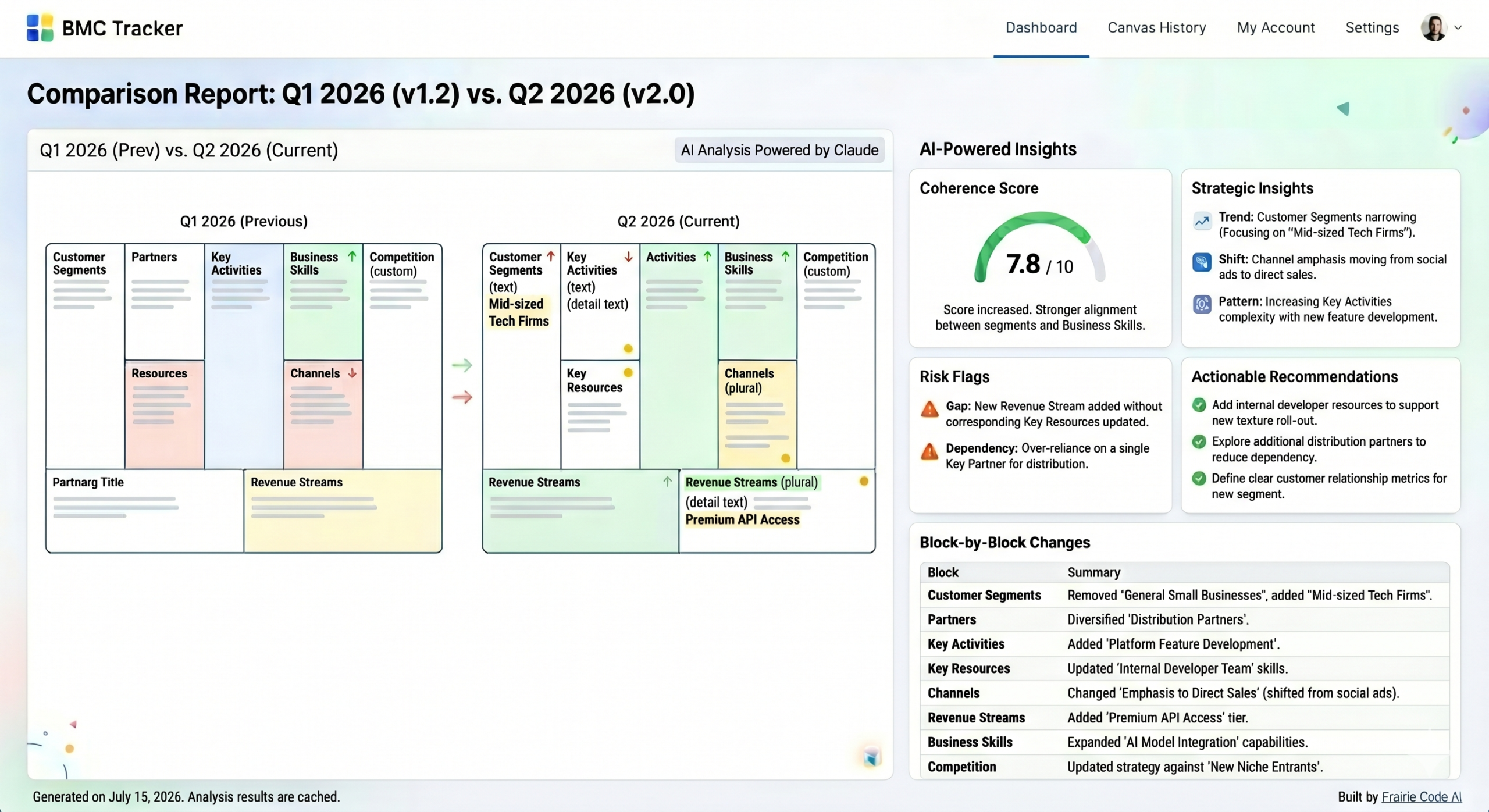
BMC Tracker is a web application that stores every version of your Business Model Canvas and uses AI to analyze how your business model evolves over time.
The core workflow:
- Create an account and set up your business.
- Fill out a Business Model Canvas. The app walks you through all 9 blocks with clear prompts and helper text for each one.
- Save it. The app timestamps and versions your submission automatically.
- Come back later (a month, a quarter, whenever your business changes) and fill out a new version. Your previous answers pre-fill the form so you only edit what’s changed.
- Compare any two versions. The AI engine analyzes the differences and generates a full strategic report.
The AI comparison report includes:
- Block-by-block change detection. What moved, what stayed the same, and how significant each change was.
- Strategic insights. Pattern recognition across your changes. If you’ve narrowed your customer segments three times in a row, the report surfaces that trend and what it means.
- Risk flags. The AI identifies inconsistencies in your model. Added a new revenue stream but didn’t add corresponding key activities or resources? That’s a gap. Over-reliant on a single customer segment? That’s a risk.
- Actionable recommendations. Specific next steps based on the analysis, tied to the blocks they affect.
- A coherence score. A 1-10 rating of how well your 9 blocks work together as a unified business model, with an explanation of why.
Set a reminder cadence (monthly, quarterly, twice per year) and the app sends you an email when it’s time to fill out your next version. No more forgetting.
Who It Serves
BMC Tracker serves three groups:
- Individual business owners who want to track how their business model evolves as they learn, grow, and adapt. Especially useful for businesses in transition, whether that’s launching a new product line, entering a new market, or pivoting strategy.
- Business coaches and consultants who assign the Business Model Canvas to clients. BMC Tracker gives them a central place to see how their clients’ models develop over time, with AI-powered insights they can use in coaching sessions.
- Economic development organizations, SBDCs, and university entrepreneurship programs that teach the Business Model Canvas in workshops and courses. BMC Tracker turns a one-time classroom exercise into an ongoing strategic tool that students and clients continue using after the workshop ends.
How It’s Built
BMC Tracker runs on a modern, lightweight stack designed for low maintenance and low operating costs:
- Next.js for the web application (server-rendered React with TypeScript).
- Supabase for authentication, database, and row-level security. Every user sees only their own data.
- Anthropic’s Claude API for the AI analysis engine. Canvas data is small (under 1,000 words per submission), so each analysis costs pennies to run.
- Vercel for hosting and deployment.
The AI analysis results are cached. Once a comparison report generates, it’s stored and served instantly on repeat views. This keeps API costs predictable even as the user base grows.
The Business Case
BMC Tracker fills a validated gap. Academic research on business model evolution has identified the need for tools that track transformation between canvas versions. Existing tools (Strategyzer, Canvanizer, Miro templates) let you create a canvas. None of them treat it as a time-series data object with AI-powered analysis across versions.
The pricing model is simple: Small monthly subscription. Low enough that any small business owner or consultant can justify it. High enough to sustain the product with a modest user base.
Current Status
BMC Tracker is in prototype with early users testing the core workflow. Feedback is being collected from business owners, SBDC advisors, and university contacts to shape the full product before a public launch.
If you’re interested in early access or want to discuss how BMC Tracker could integrate with your business coaching or economic development program, reach out at hello@prairiecode.ai.